Clicking buttons for a living [Part-1/n]
It’s almost been a year since I have been playing online poker professionally, and while it has been moderately successful for me personally, I often feel there is a lot of misconception about the sport. Some view it as a get-rich-quick scheme, some as gambling while there are others who look at it a nerdy pastime (the last being closest to reality, but not quite). Recently, I have also been asked by several people with some level of interest in poker as to how they can improve their game, whether they should transition to playing the game full-time, and how does the life of an online poker grinder look like. Finally, there are others with a purely business interest who are keen to understand how the ecosystem will evolve, how does the regulatory landscape look like, and if poker will play a key role in the growing gaming industry in India and across the world.
Lots of questions, so I decided I would do an n-part series trying to answer some of these as objectively as I can. Given my expertise is in a particular format of poker (online multi-table-tournaments or MTTs), I will stick to what I know best. I will also assume that anyone reading this has a basic understanding of the game, and has played the game casually at the minimum.
Online Poker tournaments – the business model
There are several websites which offer poker tournaments, the most prominent ones in India being Adda52, Pokerbaazi, Poker Stars India, Spartan Poker and 9stacks. All of these are legitimate tax paying businesses. The way these businesses make money is buy charging a fixed fee from each customer on every tournament played. So if there is a tournament on Pokerbaazi with an entry fee of Rs 5,000 (~70$) and 1,000 people end up playing it, the total prize money collected is Rs 50,00,000 (~70,000$). The operator (Pokerbaazi in this case) usually keeps about 8-10% of the total prize money, and the remaining is distributed among winning players. Winning players for a particular tournament are usually 10% of entrants, so in this case the top 100 will get a share of the remaining Rs 45,00,000 (As 10% or Rs 5,00,000 has been taken by PokerBaazi for organizing the tournament). The way the actual prize money is distributed is non-linear, but typically the payouts are such that the player who comes first gets around 15-20% of the total prize money (in this example about Rs 8-9 lakhs or ~$12,000, and the person who finishes just ‘in-the-money’ (in this example 100th), would make 1.8-2 times their buyin, or about Rs 10,000 (~$140).
Below is the prize distribution structure of a tournament on Pokerbaazi with an entry fee of Rs 5,000 and Rs 500 as organizing fee or ‘rake’.
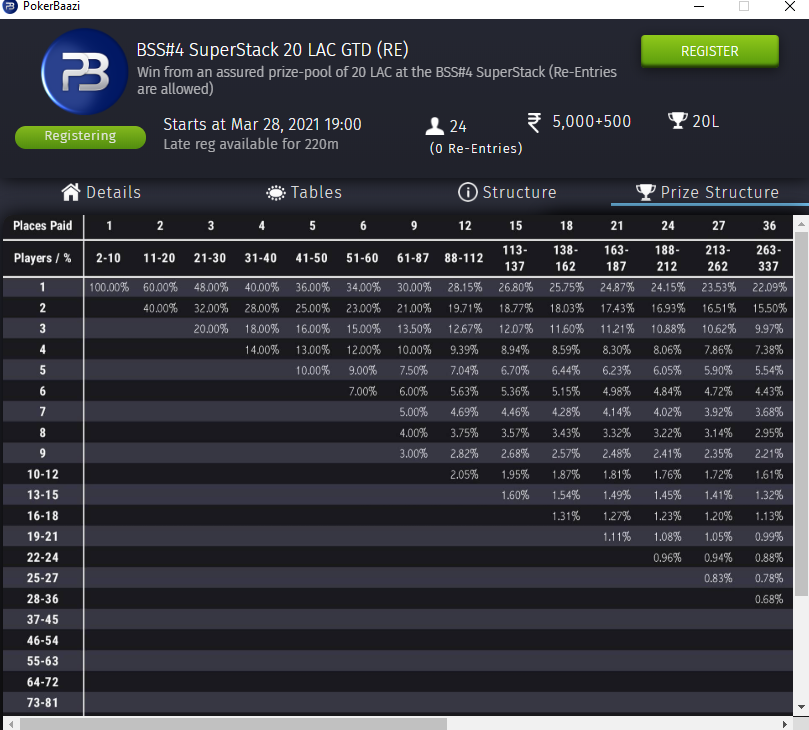
An obvious question which may come to mind is that this appears to be a very lucrative business model – operators get to keep a flat fee on every entry with virtually zero costs (only tournament hosting on servers and software development) but this is not strictly true. Poker operators have several other costs, which I list below:
- Meeting tournament guarantees – Since there are a lot of operators (thanks, capitalism) in India, poker operators have to ensure a minimum guarantee in prize pool for every tournament. So in the above image, Pokerbaazi is guaranteeing a minimum of Rs 20,00,000 (or 28,000$) in prize pool. This means that the operator estimates that it will be able to attract a minimum of 400 entries, and in the scenario it is not able to do so, it has to fulfil the shortfall. So if only 200 entries are logged for the above tournament on March 28, then Pokerbaazi has to generate the remaining prize money (Rs 10,00,000 or 14,000$) from its coffers.
- Marketing and customer acquisition – It is in the interest of poker operators that they keep on growing the player pool. They spend a significant amount of money on promotional activities, hiring brand ambassadors, offering discounted tickets and so on.
- Transaction costs – This often gets missed, but for every transaction made on a poker platform, operators also have to pay a transaction cost. So if you as a player deposit Rs 15,000 (or 200$) and withdraw Rs 10,000 (or about 140$) the next day, the cost of transaction is typically borne by the operator and can be about 2-5% depending on the underlying mode of transfer.
Despite all the above, it is indeed a fairly lucrative business. Adda52, India’s leading online poker operator, grossed Rs 162 cr (~22 million USD) in revenue in 2019-2020. My estimate is that roughly 25% of this comes from tournaments, and should have at least a 40-50% margin. Best part, all these numbers are growing in double digits!
F*ck the operators, how much money can I make?
First, let’s talk about how many people make any money.
Poker (like intra-day trading) is a zero sum game, so if operators are making so much money, it stands to reason a large chunk of players are losing money. Indeed, they are. In the long term, around 93-95% people end up losing money. These numbers may seem scary, but should be seen in context of other zero-sum-games like day-trading, where 97% of retail investors lose.
The major reason for winning players being so few is the rake (tournament fee) charged by operators. Every time an operator rakes in 10% of the tournament prize money, that money goes outside the prize pool, never to be seen by the players again. Globally, poker operators charge somewhere in the region of 5-8%, and as the eco-system develops in India, the rake should go down, meaning the ratio of winning players will increase from 5% to about 8-9%.
In terms of the actual amount, the 5-7% of winning players in India make a very decent living. The person who finished number one in poker tournament rankings last year (yes, these are documented) made about Rs 2,00,00,000 (or about 270,000$). Among the winning players, the average winnings for the year would be around Rs 40,00,000 (55,000$) and the median around Rs 30,00,000 (or 45,000$). Since the game has a very high element of skill, you usually see the same players winning again and again.
There are about 4,000 active tournament players in India, and not more than 150 make money consistently.
That’s it for the first part of this mini-series on online poker tournaments in India, I will be back with the next part soon!


![Clicking buttons for a living [Part 2/n] | Sanat Mehrotra's Blog Avatar](https://sanatmehrotra.com/wp-content/uploads/2022/03/qf0mrafr_400x400.jpg?w=40)
 Sanat Mehrotra's Blog
Leave a reply to sanatmehrotra Cancel reply